





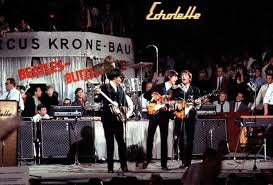
THE BEATLES IN MUNICH, JUNE 24, 1966: THE BEGINNING OF THE END ON A FINAL WORLD TOUR
On June 24, 1966, The Beatles embarked on what would be the first stop of their final full-scale world tour, performing two electrifying shows at the renowned Circus Krone-Bau in Munich, Germany. While they had dominated stages and airwaves for years, this concert marked the beginning of the end for their days on the road. The Circus Krone-Bau—an iconic Bavarian venue known for hosting circus acts, operas, and top musical talents—played host to a moment that lives on as both a celebration of Beatlemania and the foreshadowing of its fading flame.
The Beatles played two sets that day, one in the early evening and a second later that night. Both were performed to a crowd of over 3,000 ecstatic fans each, though the music was often drowned out by the deafening roar of the audience. It was clear that the disconnect between their increasingly sophisticated studio sound and the chaos of live performance was growing. Their onstage energy was still magnetic, but the band members were beginning to feel the weight of fame and the wear of life on tour.
What set this show apart, historically, was the presence of a television crew from Zweites Deutsches Fernsehen (ZDF), Germany’s national broadcaster. ZDF filmed the second performance and backstage moments, later airing it on July 5th as a TV special titled “Die Beatles.” It offered millions of fans across Germany a rare glimpse behind the curtain at the world’s biggest band and remains one of the few professional recordings from the 1966 tour.
The setlist leaned heavily on crowd-pleasers: “Rock and Roll Music,” “She’s a Woman,” “If I Needed Someone,” “Day Tripper,” “Baby’s in Black,” “I Feel Fine,” “Yesterday,” “Nowhere Man,” “Paperback Writer,” and the raucous closer “I’m Down.” Notably, despite having just finished recording Revolver only two days earlier, no songs from the album made the setlist—a reflection of how unsuited their newest material was for live replication amid the chaos.
Though the Beatles still had several tour stops ahead—in Tokyo, Manila, and finally the infamous final performance in San Francisco on August 29—the Munich concerts signaled a change. It was a professional, polished, and historic show, but for the band, it was also an uncomfortable reminder that live shows had become a burden rather than a joy.
The footage from “Die Beatles” remains a precious time capsule. It captures the band just as they stood on the edge of transformation—moments away from retreating into the studio and embarking on the most creative and influential recording period of their career.
In retrospect, June 24, 1966 wasn’t just the start of a tour. It was the beginning of The Beatles’ goodbye to live audiences—and their first step toward redefining the very idea of what a band could be.