


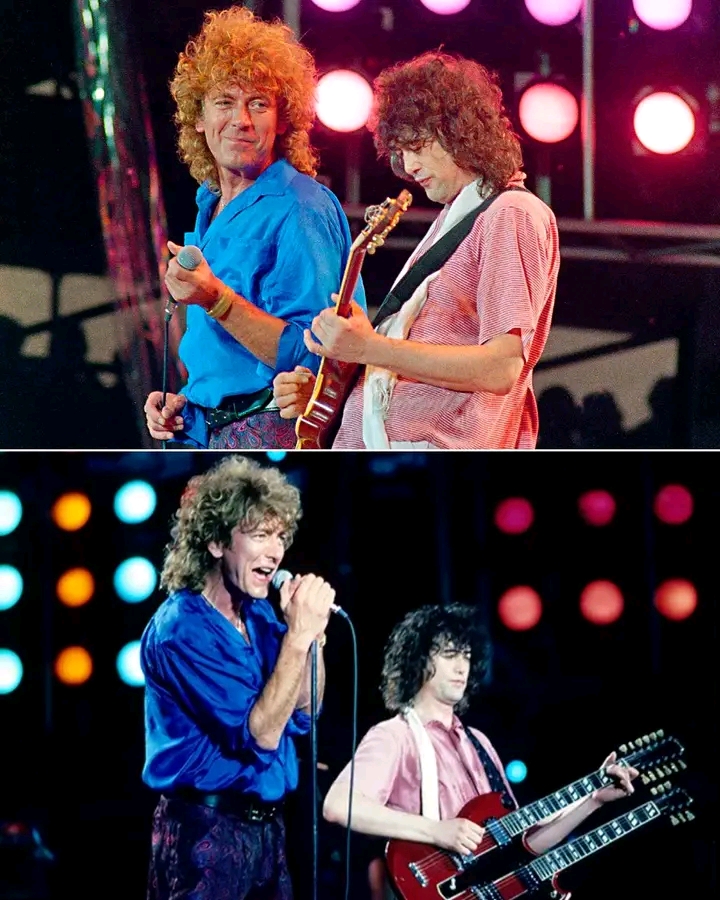
A broken reunion beneath the heavens — when **Led Zeppelin** took the stage at **Live Aid** in July 1985, the world stopped to remember what once was and to see what might still be. For a generation raised on the thunder of “Kashmir” and the poetry of “Stairway to Heaven,” it was as if time had folded back on itself. But this was not 1973 anymore. The lights were brighter, the hair was thinner, and the weight of history hung heavy over every note.
Robert Plant, Jimmy Page, and John Paul Jones stood reunited for the first time since John Bonham’s death in 1980 — a wound that had silenced the greatest rock band of their age. Behind the drums sat Phil Collins and Tony Thompson, brave souls trying to fill an unfillable void. From the first chords, it was clear: this was not the same Zeppelin. The chemistry that once burned through stadiums had dulled into something fragile, almost mournful.
When “Stairway to Heaven” began, it didn’t sound like an anthem — it sounded like an **apology**. An apology to Bonham, to the years lost, to the millions who still believed in miracles. Plant’s voice cracked, haunted by ghosts only he could hear. Page’s guitar wandered like a man chasing his own shadow — brilliant, but burdened by memory. And yet, in those imperfect moments, something transcendent happened.
It wasn’t the invincible Zeppelin of the past. It was three men facing their own mythology, stripped of illusion, standing beneath a sky heavy with history. The performance faltered, but it bled truth — a reminder that even gods grow old, and sometimes the beauty lies not in perfection, but in the **ache of remembering** what once was. Unpolished, human, unforgettable.