




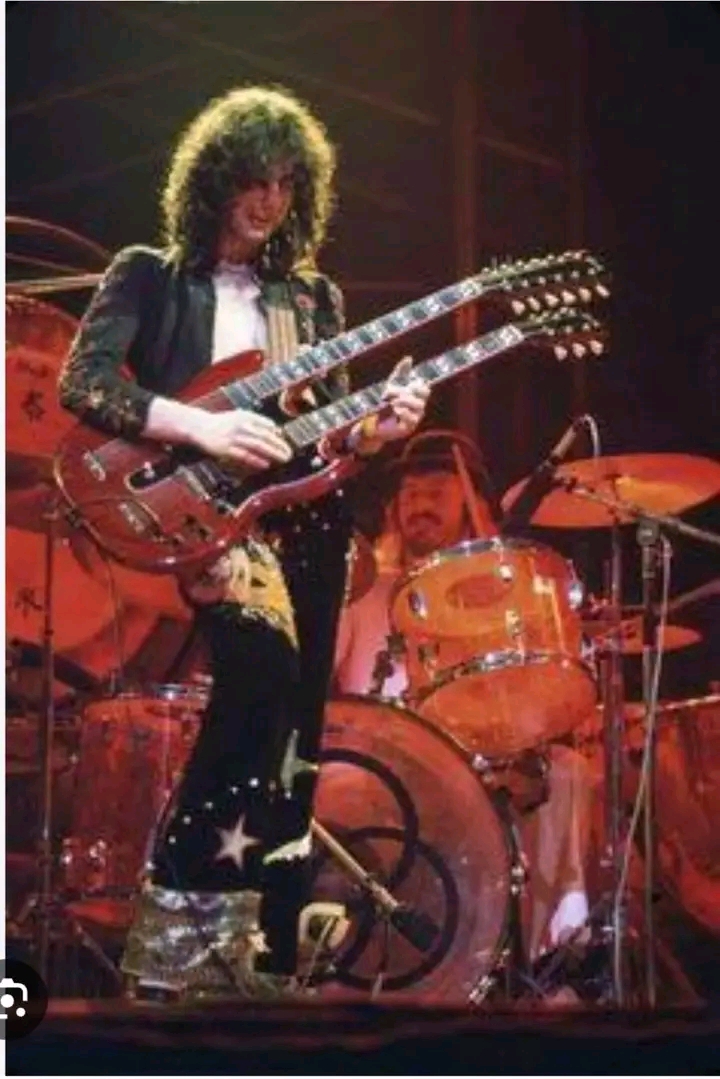
Jimmy Page: the best guitarist of all time—undisputed. And never was that more evident than in 1975, during Led Zeppelin’s legendary *Physical Graffiti* tour. At this point in his career, Page wasn’t just playing guitar—he was bending time, space, and sound with every note. With his iconic Gibson Les Paul slung low, he moved like a sorcerer on stage, conjuring a blend of precision and chaos that defined the very essence of rock.
Each performance was a masterclass in contrast. One moment, Page would deliver a delicate acoustic passage, fingers fluttering with grace; the next, he’d unleash a thunderstorm of distortion that shook the rafters. His control over dynamics and mood made Zeppelin’s shows feel like cinematic experiences—no two ever the same. On “Kashmir,” his guitar didn’t just drive the rhythm—it *lifted* the song to mythic heights, weaving Middle Eastern influences into a colossal sonic tapestry. And in “Dazed and Confused,” Page’s use of the violin bow was nothing short of hypnotic. Under black lights and swirling fog, the eerie drones and echoes he summoned felt supernatural—pure theater, pure genius.
But beyond the theatrics, 1975 showcased Page’s evolution as a bandleader. He was the architect of Zeppelin’s sound, the man behind the curtain arranging sprawling setlists, elaborate compositions, and seamless transitions. The *Physical Graffiti* tour captured Zeppelin at their most expansive, and Page was its beating heart—equal parts craftsman, visionary, and wild-eyed mystic.
It was on this tour that Jimmy Page didn’t just *prove* he was the greatest—he *defined* what greatness looked like for a guitarist. Decades later, those performances still echo, studied and revered by generations of musicians and fans alike. Page wasn’t just leading a band—he was shaping history, one blistering solo at a time. #JimmyPageF
orever