


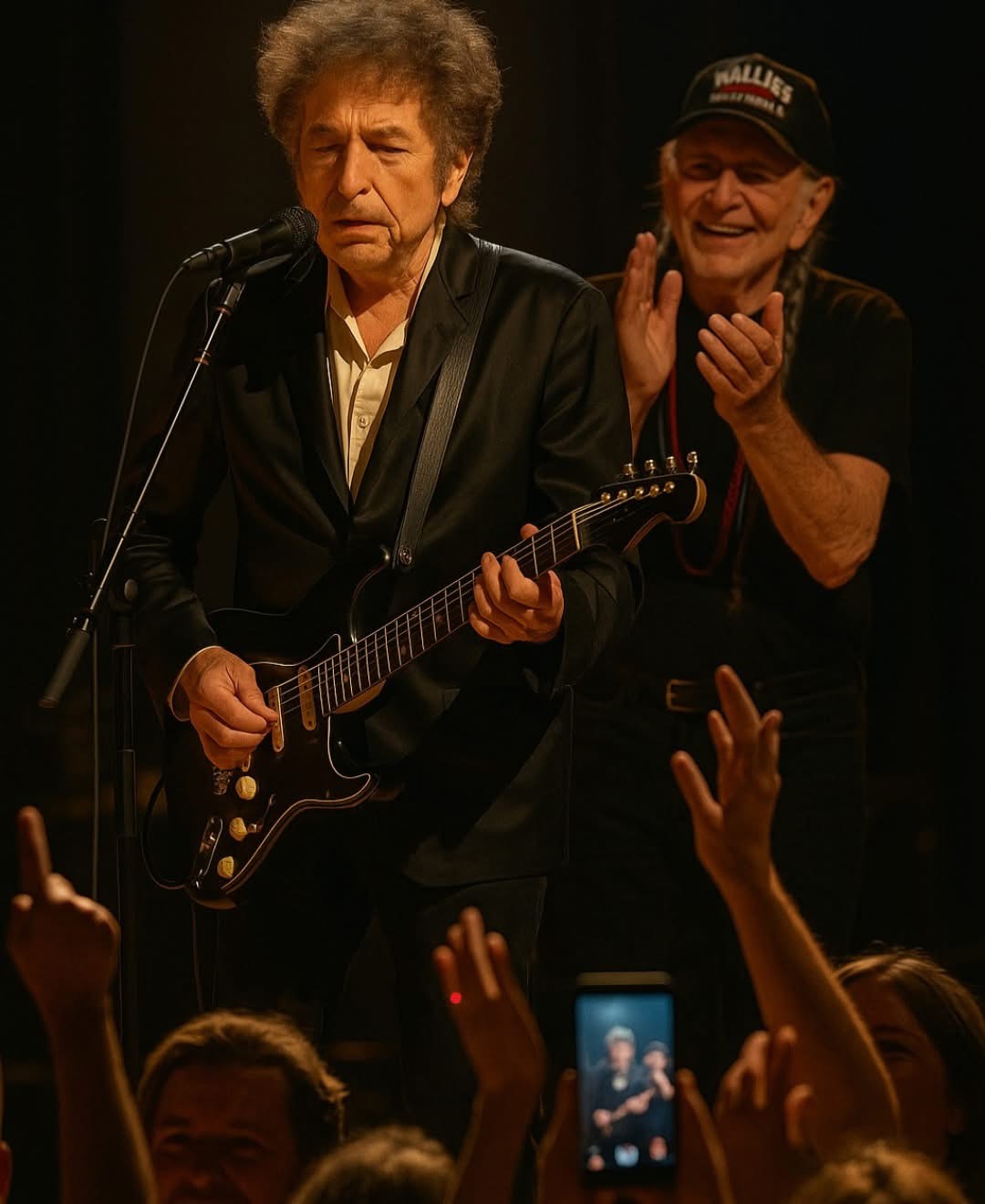
The crowd didn’t know it yet—but they were about to witness one of the most hauntingly beautiful moments in live music history. It happened without warning, without fanfare, beneath the wide-open skies of Willie Nelson’s Outlaw Music Festival. The stage lights dimmed just slightly, and there stood Bob Dylan, weathered as time itself, his silhouette framed in amber glow. Then, like a whisper across decades, the unmistakable opening chords of The Pogues’ *“A Rainy Night in Soho”* drifted from the speakers.
A stunned hush fell over the audience.
Dylan didn’t just *cover* the song—he *inhabited* it. His voice, ragged and tender, carried the weight of every year he’s lived and every song he’s sung. Each word came out like a memory he wasn’t quite ready to share, yet couldn’t hold back. The verses unraveled slowly, reverently, as if he were writing them in real time with his breath.
And then the harmonica—mournful, raw, and impossibly intimate. It cried between the lines like a ghost slipping through the cracks of the song. People didn’t cheer. They didn’t move. They just listened. Held in that moment like a photograph developing in the dark.
It was more than a performance. It was Dylan channeling something eternal: a tribute to the late Shane MacGowan, a confession etched in melody, a communion between legends separated by style but united in spirit. For a few minutes, time bent. Generations blurred. And everyone in that crowd—old fans, new fans, strangers drawn together by song—knew they were witnessing something sacred.
When it ended, the silence lingered. Then, as if exhaling, the crowd roared—not in frenzy, but in reverence. Because they’d seen Dylan do the impossible: make someone else’s song feel like it had always belonged to him.