

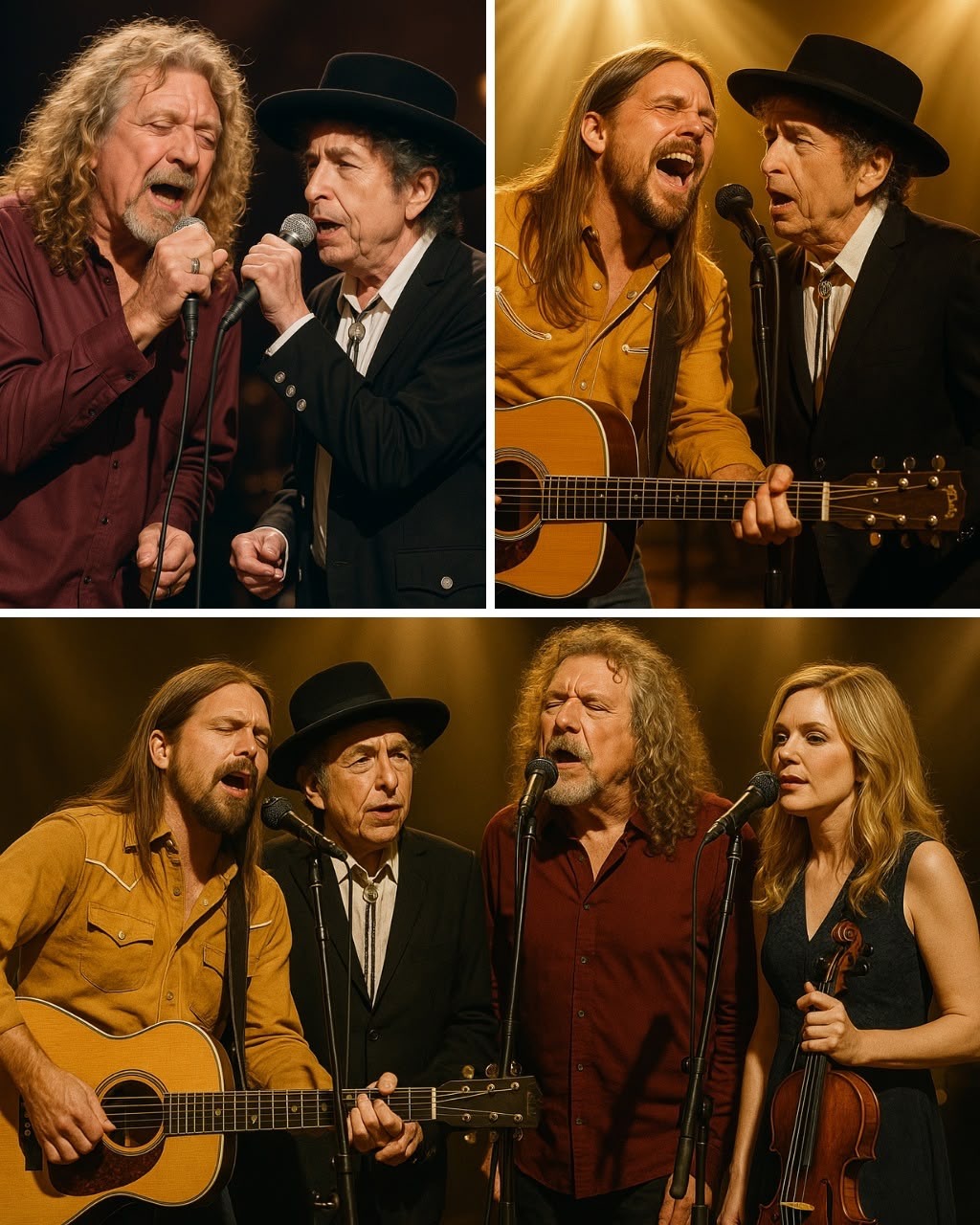
When news broke that Willie Nelson was too ill to take the stage, the air at the Outlaw Music Festival shifted. Thousands fell into a hush, hearts heavy with disappointment, bracing for a night that would feel incomplete. But then, without ceremony or spotlight, Lukas Nelson walked onto the stage. There was no grand announcement—just quiet resolve. A son stepping into an impossible space.
Surrounded by musical giants—Bob Dylan, Robert Plant, Alison Krauss—Lukas didn’t try to fill his father’s boots. He simply stood in them for a moment, steady and reverent. And when he began to sing “Funny How Time Slips Away,” the silence turned electric. His voice—haunted, tender, raw—carried not just the melody, but the weight of legacy. It wasn’t mimicry; it was memory. It was love.
The crowd leaned in. Some wiped away tears. Others simply closed their eyes and listened. In that moment, Lukas wasn’t just performing—he was healing. The ache of Willie’s absence softened, replaced by something intimate and powerful. He wasn’t trying to *be* Willie. He was *with* him, carrying his spirit like a torch in the dark.
As the final notes hung in the summer air, the crowd erupted—not out of obligation, but out of gratitude. They came to see a legend and instead witnessed a legacy in motion. Lukas reminded them that the outlaw spirit isn’t confined to one man. It lives on—in music, in memory, in blood.
What could have been a night defined by absence became a testament to presence. Willie wasn’t on that stage, but his voice echoed in his son’s. And as Lukas stepped back into the shadows, the flame still burned—fierce, beautiful, and unbroken.